Tag: Disruption

  • Did I miss something…?

    Did I miss something…?

    Last week saw the release of the latest radio surveys (ie, the all important audience figures).

    Commercial radio in NZ is a virtual duopoly,  with MediaWorks and NZME taking turns to whack on each other. So I guess it shouldn’t surprise both sides “see” the latest results as victories. Even so, I’m struggling to see Paul Henry a surprise winner in radio survey in the same space as Hosking dominates breakfast radio.

    The release of the numbers saw further PR salvos – Dean Buchanan (managing director NZME Radio) was “…rapt with today’s results. Newstalk ZB will just continue to strengthen further with Marcus Lush joining the team”. He also claimed “ZM is on fire with loads more growth potential… it’s a great day to be number one”.

    Hmmm…

    I completely understand the rhetoric. In a two player market appearance is all, and moves in share mean moves in revenue. But…

    These announcements are shy any comment on the real-world challenges facing radio.

    Total market audience figures give a reality check – total audience dropped by 7.9%. Drilling into ZM and The Edge (as a proxy for youth) 9.2% of the audience disappeared. These are big numbers to be deserting radio – the impact of audience loss is clearly seen in NZME Radio’s results, where revenue dropped 2% in 2014.  However, there was more to the story than meets the eye, agency revenue (the largest and most sophisticated advertisers deserted NZME radio a massive 13% in Q2.

    And if you think this is grim, the future looks even worse for traditional TV.
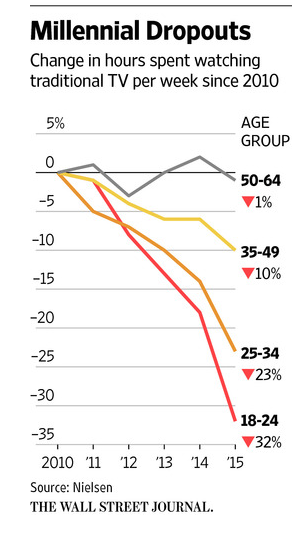
    TV with MillennialsThe latest Ericsson TV & Media 2015 report shows the massive impact of generational change on media – 82% of 60-69 year olds still watch traditional TV compared to 50% of 16-34 year olds.

    Chiming with this is a graph from WSJ. The 18-24 demographic shows a 1/3 drop in hours spent watching traditional TV… in only a five year period.  

    TV is pushing on demand and online services to arrest this decline. So is NZME with iHeart Radio. Papers and cracks… these attract audience but mean little without thought through corresponding (and company-wide) commercial strategies to arrest cash declines.

    Advertising carries less impact in digital channels. Global forecasts see TV losing between between 1-3% of advertising revenue share in the next 5 years globally, but guess what this again is masked by the fact that it is only really emerging markets that are growing.

    You’re thinking – 1-3% isn’t much versus the general audience decline, right? And you’re right.

    The issue is – media companies work on thin margins already. TVNZ had revenue of $336m and profit of $25m in 2014. Profit margins are so finely tuned that on those numbers a 7% drop in revenue would completely wipe out TVNZ’s profit.

    Here in NZ our smaller base is driving us faster to the sharp end of disruption for traditional media. To assume things will change is wishful at best, misleading at worse. The challenge for media companies is to show how they will adapt, versus hacking at each other over smaller pieces of an increasingly decreasing pie.

    The options of cutting are diminishing (to gone), so it will be fascinating to see which of them can pivot into a real-world place, based on a genuine understanding of where their audience and clients have gone. Despite executive comment on the healthy state of media most realists get that inaction is making the future worse. The fear is significant pain lies ahead.

    Key Takeaways

    • Topline numbers can give a false sense of security. Is your business realistic in its world view?
    • What do you see when you look closely at your lead indicators? Comfort or trouble?
    • If trouble… how are you tackling that?
    • Strategy and leadership is all about understanding trends and identifying the future shape of your business. It’s difficult to achieve when you’re in the trenches… do you carve out time to understand and plan for the future?
  • How can it be free?

    How can it be free?

    Weve touched on Chris Andersons celebrated 2009 book Freea few times in previous posts. Not the easiest read (theres a lot of technical detail that can be difficult to follow) the book is actually based on another, equally celebrated (and luckily for us, much more accessible), piece from Anderson – the 2008 Wired magazine article Free! Why $0.00 Is the Future of Business.

    Anderson was Wired editor in chief for over a decade (moving to Wired from the Economist in 2001), with a deserved reputation for work examining digitals impact on legacy business (his other – equally celebrated – work is The Long Tail). I clearly recall the impact the original article had when I read it in Wired, and having recently re-read the piece eight years on its striking how much there is still be gained from its basic concepts.

    The article starts with an economic principle – in a competitive market, price invariably falls to the marginal cost. Two digital factors today put this principle in overdrive – in demolishing international boundaries the internet has created previously unimagined avenues to scale, with centralised resources now serving millions (and billions) globally, building the most competitive market ever. And alongside this Moore’s law seemingly defies natural laws, every year enabling exponentially more powerful service to that audience of millions, and at rapidly decreasing cost.

    And heres what that does to business – as your primary expense reduce to silicon based services, free moves from an option to the inevitable endpoint.

    Or as I may have mentioned last weekif it can be digitised it can be disrupted.

    New businesses utilising free are incredibly disruptive and destructive to legacy businesses, hamstrung with digitally insensible strategies and systems. These business enter the market and rapidly strip value from their legacy competitors – all the while operating commercially successful and digitally coherent strategies.

    Craigslist (a US version of TradeMe) began service in 1995 as a free email service featuring events in San Francisco. Evolving into a classifieds site offering free basic listings with upsell and advertising around them, by 2006 it had helped to strip some $326m (or 12%) from the value of the US classified business for newspapers. Craigslist was estimated to be earning $40m – but with of course a drastically different cost base to newspapers. The balance of value simply disappeared – nine years on from 2006 I would wager the value now stripped out of US classifieds would be closer to 95%!

    The most common free model requires three parties (the basic media model). In this model an advertiser pays to participate in an otherwise free exchange between a content producer and an audience.

    Google is probably the three party proponent most people know of – offering a seemingly unlimited number of highly featured free services (search, apps, youtube, Google Drive, unlimited photo storage) to its customersall funded by a sophisticated advertising model.

    Other common free models include:

    Freemium:

    • Usually with web software, services, and some content free
    • Free to basic users of the service
    • Example: Evernote.com  

    Advertising:

    • Usually with content services, software and more offered free
    • Free to everyone
    • Example:  www.nzherald.co.nz

    Cross-subsidies

    • Driven by a second product enticing enough for you to pay for
    • Free to everyone willing to paybe it one way or another
    • Example: Mobile phone bundled calling plans

    Labour Exchange

    • recaptcha-booksUsually with free websites and services
    • Free to all users, with the act of using these sites and services being the value driver
    • Example: When you are entering the key words in a scrambled text box on a log in screen you are actually helping transcode a book


    Gifting Economy:

    • Usually with free open source software or user generated content
    • Free to everyone
    • Example: Wikipedia

    Key Takeaways:

    (and, I really hope this ones getting through)

    • If it can be digitised it can be disrupted!!!
    • In a digitised world there is a race for scale, with costs plummeting, meaning free may become inevitable

    Key Questions?

    • Have you considered your industry may be headed toward free?
    • Are you seeing reductions in your input costs?  
    • If this is happening, how will you evolve your commercial model to compete and compete profitability?

    KS

  • If it can be digitised it can be disrupted

    If it can be digitised it can be disrupted

    If it can be digitised it can be disrupted…

    The role of the consultant is two-fold. Sometime you get paid to help your client see and achieve things they don’t have the resource or experience to do… the classic hired gun lending expertise to pivot a client’s business to a higher place.
    The reality is that’s quite rare – usually it’s a little more pragmatic. That doesn’t mean less valuable – just more “everyday”. That’s about helping a clientrecognise risk, understand where the market is heading, navigate choppy waters, change, and then emerge fit for new purpose.

    If it can be digitised it can be disrupted…

    A good consultant does both. A great consultant understands helping a client survive and thrive, staying in their vertical with minimal changes to their model delivers the gold.
    In the last few years a new breed of consultant has emerged – one schooled in public policy and corporate relations. These are the guys who push the envelope for new digital technology and thrive on challenging the regulatory
    status quo. Armed with consumer driven support (for cheaper and more “consumer friendly” digital innovation), political  backgrounds give them the contacts and knowledge to change industries through challenging regulations.  In many digital businesses they earn the biggest salaries and assume the same sort of importance as a valued COO.

    If it can be digitised it can be disrupted…

    So what, you might think. That sort of stuff is a little above my pay grade. But here’s the thing – what these guys do doesn’t just impact their business. It can directly  impact your business too. The goalposts they shift can render you obsolete in the blink of an eye, and just as in last week’s post, you may not see the wallop coming.

    Media and the taxi industry delivered great examples in the last week. In Europe, contracts between Sky TV UK and six Hollywood studios are under investigation by the European Commission. Clauses in their distribution
    contracts demand Sky block access to content outside of their licenced territory (eg, geo-blocking outside of the UK).  This has been standard in distribution contracts for years – technological shortfalls supported the policy,
    and it meant studios could sell the same content multiple times into multiple different territories. In today’s borderless (internet distributed) streaming environment, the policy makes less sense. And in the economically borderless EU, the Commission has averted interest in a consumer focussed level playing field for all content consumers.

    Meanwhile, in NYC aggressive and innovative marketing has driven Mayor Bill de Blasio to at least temporarily back down from his plans to hit Uber by limiting the number of ride sharing cars allowed in the city. Driven by union pressure from the Taxi and Limousine Commission (which has seen the value of a taxi license decrease by 20% since 2011), De Blasio tried to go the ecological route, citing increased congestion and pollution as reasons to limit
    ride sharing vehicles in the city. It is estimated that there are 63,000 Uber type cars in New York compared to a regulated and capped 13,500 yellow Taxis.

    If it can be digitised it can be disrupted…

    Both these industries had strong historic forms of market protection. Pressures ranging from consumer through to regulatory, all driven by digitisation, have utterly eroded these natural barriers to entry.  Laws governing these businesses were not written for digital environments, however the businesses were able to be digitised and thus disrupted. When the laws couldn’t keep up, public policy agitation became part of the disrupters arsenal – ultimately meaning wholesale change for everyone attached to both industries.and challenged by the net result This is not only a major headache for the incumbent businesses but for lawmakers as the law was not written with the digital and sharing economy in mind and is fraught with un-intended interpretations and consequences.

    Key Takeaways

    • You may have some form of technical or regulation protection for your business of industry however when your business, value chain or parts of your value chain are being digitized:
      • Will they offer the protection you need?
      • How will they be interpreted,
      • Will they need to be reworked and therefore remove your protection
    • If you have a restraint of trade with your talent, does it apply to your existing medium or web and mobile?Remember if it can be digitised it can be disrupted!

    KS

    PS: In a similar vein, the Top Gear guys have just neatly circumvented a contractual restriction on. And just off the wire is the news that the Top Gear crew have signed for Amazon Prime Video, the interesting thing about this was the presenters contract restricted them from hosting another TV car show on British television, Amazon Prime is a global deal and circumvents this restriction.

  • Six Stages of Exponential Growth

    Six Stages of Exponential Growth

    In the last week I’ve been hooked on a fantastic new book – Bold: How to Go Big, Create Wealth and Impact the World. Demonstrating the impact technology is having on change (and how technology-driven change can only continue to increase) the book has really expanded my thinking on the opportunities this is opening. It’s changed the way I view the growth of technology and its impact on both new and established businesses.

    Underpinning the book is a simple concept. Growth today is exponential and no longer linear – instead of thinking of growth as “1, 2, 3, 4 5” we should think of growth as compounding or doubling i.e. “1, 2, 4, 8, 16”.

    Likening this new growth paradigm to Einstein’s famous quote (“Compound interest is the eighth wonder of the world. He who understands it earns it … he who doesn’t pays it.”) the authors Peter Diamandis and Steven Kotler see it as imperative you disrupt your own company before someone else does. With the exponential nature of technology-driven growth, standing still is now the business kiss of death.

    The book outlines the “Six Stages of Exponential Growth” – or the Six D’s (Digitalisation, Deception, Disruption, Demonetisation, Dematerialisation, and Democratisation).

    Digitalisation – Everything is going digital, be it images, words, music, video or communications. And once digital, it then is subject to exponential growth as defined by Moores law.

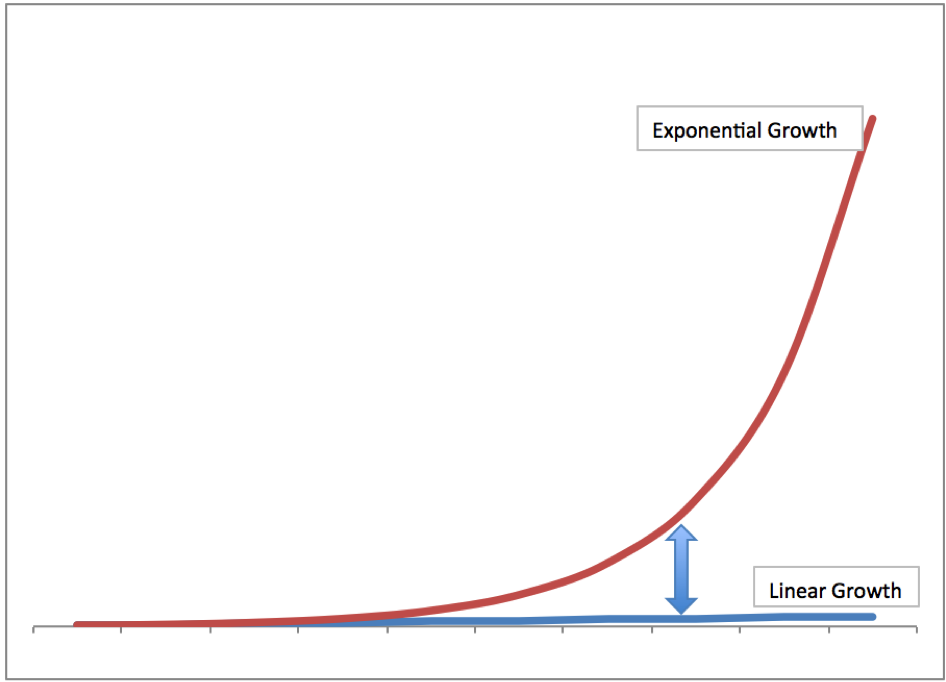
    GraphDeception – As things and products are digitised it can take time for them to hit their straps. The hype around their digitisation can falter, allowing products to fall into a deceptive period where people dismiss them. This period is doubly deceptive – despite possibly growing at a compound rate, in the early phase compound growth is not noticeably different from linear growth. The graph below illustrates this – by the time the difference between exponential and linear growth becomes noticeable the pattern is already set to explode.

    Disruption – Digitalisation increases the options for disruption – innovation and technology will either create a new market or disrupt an existing one. Unfortunately for the disrupted, disruption always follows the deception period… the initial technological threat may seem laughably insignificant in the deception stage – by the time you clock onto the growth it often has unassailable momentum.

    Demonetisation – This is when money gets removed from the equation. Referencing Chris Anderson’s Free, the authors show one of the easiest ways to make money through utilising “free”. Free was written in a coffee shop, on free wi-fi, and on a $400 netbook, utilising free Google apps. There are many examples that show this, be it Wikipedia vs. Encyclopedia Britannia or Skype vs. long distance/toll calling.

    Dematerialisation – This is when form factors change or converge, resulting in the disappearance of some goods and services. Smartphone apps are perfect examples – a phone has now replaced the calculator, the camera (still and video), the game console, the GPS, the alarm clock, even now even the iPod. Kodak’s first digital camera was 0.01megapixels, weighing 2kgs and costing approximately $US10,000. Today a 10+ megapixel camera weighing less than comes “free” with every 15 gm smartphone…

    Democratisation: This is when access becomes universal when the Masai herdsman with a smartphone can just as easily learn agri-business innovations as the Waikato farmer. Phones are deep in this phase right now – there are forecast to be 1 billion mobile phones in Africa by 2016.

    Key Takeaways:

    For me, the book’s key insights are in the first three Ds – Digitalisation, Deception and Disruption. I think they generate these five key questions:

    • Has any part of my business been digitised, and how can it be?
    • Think hard before accepting your business cannot be digitised. Consider Uber and AirBnB – they both digitised businesses traditionally considered safe due to high barriers to entry, and requirements for physical infrastructure such as cars and hotel rooms.
    • What digital trends in the couple of years have since fallen out of favour due to lack of growth – is this classic deception phase?
    • What part of my business should I be digitising and disrupting myself, getting ahead of the curve before I’m hit by new competition?
    • What does free look like for my business model?

    KS

  • Global Mode decision offers a small reprieve

    Global Mode decision offers a small reprieve

    Following an earlier blog post Hollywood Disruption, this week came the news an out of court settlement had been reached between a group of media heavyweights (Sky, Lightbox, Mediaworks, and TVNZ) and the ISPs who had been offering their customers global mode.

    Background

    Global mode is a VPN service that lets users circumvent location restrictions (also known as geoblocking), allowing access to content previously blocked in a user’s territory. Global mode lets a user mask their actual location, appearing as if they are in the US – meaning they gain access to content usually only available to a US consumer.

    Access to providers like Netflix US or Hulu gives New Zealand based consumers a wider range of content, often at cheaper rates. Content is often available in the US before NZ, giving global mode users a much better deal than New Zealanders accessing content through local providers. Unsurprisingly NZ broadcasters see global mode as a threat – their addressable market is diminished and “exclusive” content (paid for by the providers at a premium) ends up widely available. Hence the decision to challenge its legality in the courts.

    Predictably there was a strong customer backlash against the closure of global mode on consumer forums (jncluding threats to cancel and boycott the local providers who had taken the case). However in seeking to protect geographic exclusivity the media companies did the right thing for their shareholders. Though using a VPN to access overseas services is relativity easy to do, for the time being it remains the domain of early adopters. The threat of such a service moving mainstream was obvious – keeping it out of the mainstream could be worth millions and, crucially, extend the runway in a sector certain to face headwinds and difficult strategic decisions in the near future.

    Headwinds.

    Any celebration amongst the media companies over the end of global mode will be short lived. This victory does nothing to diminish the deeper strategic issues that both traditional broadcast and pay TV media are grappling with. These include:

    1. Content Part 1… as argued on a previous blog territorial deals will become global deals. Local providers will struggle to differentiate on content.
    1. Content Part 2… distributors are moving onto the producers’ turf. Amazon and Netflix now produce Emmy winning content such as House of Cards and Orange Is The New Black – local producers cannot hope to match the bottomless pockets of the tech/distributor giants.
    1. Content Part 3… original content isn’t the only battleground for local providers. The NFL and the NRL are just the start of sport looking for global deals for their output.
    1. Content Part 4… this issue is bigger than NZ. When a seemingly strong link as the BBC and the Olympics can be shattered by a global platform you start to see the size of the challenge.
    1. On top of the content challenge, viewers are deserting TV in general, often for digital. The hours a US consumer spends watching traditional TV has dropped from 147 hours to 141 hours per month.
    1. As internet has supplanted traditional delivery platforms like satellite or local spectrum rights, the cost to entry has plummeted. Accompanying this shift in delivery costs, NZ has moved in a very short space of time from one pay TV operator to one pay TV operator and five SVOD providers.
    1. For years Sky ‘owned’ the customer lounge through the Sky box. Now Apple TV, Google Chromecast sticks and Smart TVs all have the ability to transmit Netflix, Lightbox, and Neon type apps into the lounge, in direct competition to Sky. As adoption of this new technology moves mainstream this erosion will accelerate for Sky. Today approx. 50% of smart TVs are connected to the internet, ending the consumer reliance on single purpose tech for content delivery.
    1. All of this is having a deleterious impact on traditional operators’ audience. As alternative platforms grow traditional pay TV operators are suffering churn and a shrinking base.
    1. Hand in hand with a shrinking and less engaged audience comes a shrinking ad revenue. TVNZ recently reported a 5% drop in profit due to lower advertising revenue despite increasing their market share.

    Key Takeaways

    This may not have been a popular decision with consumers, but it was an absolutely necessary action for the media companies. It doesn’t bring the issue to a close, but it does buy them precious time to plan their strategic response to some of the headwinds I’ve outlined above. The hard work remains ahead… the reinvention of their business models and redefinition of their value propositions.

    And finally… as a side note I noted with interest NZ Herald’s Mike’s minute, on the subject of global mode. I was fascinated such a complex and divisive issue could be so easily misrepresented – Hoskings used the following analogy to illustrate the issue:

    • “This is like a game of rugby and the officials are selling tickets and you deal with the guy that cuts a hole in the fence and you sneak in. How is that legal or morally acceptable?”

    This conveniently skips a key part of the discussion – whether or not global mode is morally or legally correct, the content creator is still being paid. A much better analogy would be:

    • You decide to buy the US edition of Harry Potter from Amazon rather than the local edition (for which a local publisher would have paid for exclusive rights)
    • Or, despite Vodafone NZ having the exclusive rights to the Gold Samsung S6, you buy the same phone at a cheaper price, imported from another country through a parallel import business

    The obvious difference is whatever the complexities of global mode, the content creator is still valued, and being paid for their content.


    KS

  • Freemium business model

    Freemium business model

    A frequent challenge for clients in growing a digital business is identifying their ideal commercial model. In the last month I’ve worked on this question with a couple of clients – both of them wanted to learn more about “freemium”.

    The rise in freemium has been enabled in part by delivery costs for digital products or SaaS businesses decreasing to commodity level. This in turn has largely been driven by the celebrated Moore’s law. Loosely speaking, as computer power doubles every 18 months (with little incremental expense), the cost of adding an additional customer is reduced to almost zero. This frees a company to act creatively to attract new customers.

    At its simplest, freemium combines the concepts of  free and premium – a basic version of your product is given away for free on the assumption your heavy (or super) users will be willing to upgrade to paid premium features and functionality. Products such as web apps (or online software) and industries such as online gaming naturally gravitate towards freemium as it’s an easy way for a customer to “suck and see” before committing to payment.

    Producers face a delicate balance with freemium – whilst the free component of the product must have limited functionality so as to encourage consumers to migrate to the paid version, it also needs to offer enough features to satisfy a significant portion of your base. And – significantly – the producer needs to openly commit to providing this functionality for free forever, removing any customer barrier to entry.

    The established adoption model for freemium suggests 95% of your customers will never move away from free. If only 3-5% of your consumers will upgrade to a paid model, there are some non-negotiable business conditions you need to meet before considering the model:

    • Is the incremental cost of adding a customer truly close to zero for your business?
    • Is the cost to your consumer of moving from free to premium relatively modest?
    • Given a 3-5% conversion rate does your business have mass (and typically international) scale to drive strong revenue?
    • Successful freemium businesses typically have high customer interaction, with the customer returning loyally to use the product on a daily or weekly basis. Frequency builds consumer attachment which increases likelihood of conversion. Is this your business?

    The digital filing service Evernote is one of the longest running and most popular freemium businesses. With a great track record in this area, they recently tweaked their model and took the opportunity to share some of their insights around the model.

    Evernote to change premium price as CEO says ‘it was the wrong price’

    • “We launched seven years ago at $5 a month, but we realised a couple of years ago that it was the wrong price.” – Phil Libin, CEO Evernote.
    • The free version of Evernote remains “the main version”. Rather than restrict free features, the company wants people to pay because they love the upgrade.
    • The longer you use it, the more likely you are to pay for it…“In the first month, we had one-half of a percent of our users paying. After a year it was 5%… and after six years, 30% pay. So it’s more important that you stay than you pay.”
    • As the model matured, Evernote saw the opportunity to change pricing, introducing a mid-tier price and at the same time increasing the premium price.

    In one of my previous roles I inherited a freemium business – while the core platform was strong, the wider business failed to meet at least three of the conditions I outlined earlier in this piece which led to my recommendation to close it.

    1. We had the free/paid balance wrong, giving away too much, and not offering sufficient additional functionality to migrate our heavy users to paying models
    2. We got pricing wrong, believing any increase in the premium product price would impact the uptake beyond the already challenging 3-5% target
    3. We failed to consider scale. Even if we had successfully managed the product and price issues inherent in the product, we just couldn’t generate enough scale in a local business to turn our 3-5% into a profitable business.

    As an indication of the prevalence of freemium products in today’s world, it’s worth noting many of the services I use to produce this blog are freemium (and yes, while I use the free components, I am part of that 3-5% who have migrated to payment…)

    • Evernote: for capturing ideas, researching the ideas and writing the blog,
    • Picmonkey: for photo editing,
    • Mailchimp: for sending and managing the newsletter database.

    Key Takeaways

    If you are thinking about freemium, here are the big issues you need to consider:

    • Does your product have scale and reach to turn a profit from a 3-5% paying base?
    • Does your product have built into its design a daily or weekly customer engagement?
    • Does your product have functionality to appeal to a mass level of free users, and offer compelling enough functionality for your paying super-users?
    • Does your investor have the stomach (and/or deep pockets) to fund a freemium product?

    And finally, it’s crucial you are committed to your customer promise inherent in the freemium model –that the free component of your product will remain free forever.

    KS

    View Blog

  • NFL: now streaming only on the web

    NFL: now streaming only on the web

    Earlier this week the NFL announced it had inked a global streaming deal with Yahoo!.

    When the Buffalo Bills and the Jacksonville Jaguars play in London later this year, the game will be streamed globally for free by Yahoo!. The price tag is seemingly a steal at US$20m. To put this in context, NFL screening rights cost US broadcast networks around US$7 billion each year, and a thirty second commercial slot during the Superbowl costs approximately US$4.5m.

    Given a global digital deal for this game would have attracted multiple bidders (including YouTube), it seems likely Yahoo! was the NFL’s best commercial outcome.

    Under the terms of the deal, the Yahoo! platform will stream the game onto all devices (including desktops and mobile), and through apps, direct on smart TVs.

    I believe this news has ramifications for broadcasters, rights holders and of course the audience.

    Broadcasters:

    This is a milestone event – in the short to medium term this move will have minimum impact on the large US broadcasters’ audience, but in 10 years time will be considered the the beginning of the end.

    Although 37% of all time and 41% of advertising spend on media is TV there is pressure on these numbers and they are falling year on year. Worryingly for broadcasters, combined time spent digitally (ie, on desktop and mobile), passed TV in 2013, driven by the inexorable increase of mobile.

    In the local market Yahoo!’s move will most obviously concern Sky – the local media exclusivity that they have previously enjoyed around NFL has now ended. And whilst the NFL may not be the main purchase driver for Sky Sports consumers, this could signal the beginning of unbundling of Sky packages as sports rights holders aim for new ways to get cut through and monitise their audience.

    Rights Holders

    I predicted in Hollywood disruption the current stoush over local content rights would be superseded by rights holders issuing more international rights deals (instead of territorially based agreements). As both Yahoo! and the NFL will have discovered, it is easier for rights holders to negotiate with a single broadcaster, rather than having multiple contracts and distribution agreements across multiple territories.

    This may though become a ‘careful what you wish for’ moment, and the rights holders will be treading carefully. The consolidation of distribution partners may drive more power to the large platforms by removing competition, ultimately creating conditions where price is driven down, meaning a reduced payment to creators.

    Rights holders though can’t afford to sit still, and continue to look at options and new commercial models offered by digital. The NZRFU has taken the local lead, streaming an All Blacks test back in 2013 on YouTube out to international territories.

    Audience

    As with much digital innovation, consumers appear to be the winners with this move, primarily because they get access to free (albeit ad funded) content on any device in any country with seemingly no restrictions.

    The evolution of these models will not though be without some short term frustrations. As content delivery fragments, discovery may not be as simple as when it comes delivered via a packaged and externally curated sport / set top box model.

    This fragmentation could mean as a consumer I need an app for NFL, a subscription for English Premiership, a second subscription for PGA golf, and a standard Sky package for rugby. All of which means multiple apps and multiple billing relationships.

    As the digital audience grows, so does the cost to a provider of the content rights. That in turn increases the need to deliver a commercial return on each piece of content. The price I pay may rise – BUT I will have more choice, and will not have to pay for content I don’t want (as I currently do with Sky).

    However, five years out this model will look very different. It seems most likely a global platform provider such as Apple, Google (viaYouTube), Amazon or Netflix will step in. The player who can successfully bundle this content up in an easy interface and payment mechanism such as iTunes, is likely to win. Improving discovery and simplifying my billing relationships are the key drivers to this success.

    Key Takeaways

    There are two groups in NZ who will be watching all of this very closely – Sky TV and the NZRFU.

    As providers and creators they will be actively working on strategies to defend their position and or to maximize the opportunities that digital will bring.


    KS

    View Blog

  • Facebook a Publishers frenemie

    Facebook a Publishers frenemie

    Publishers have a love/hate relationship with large digital platforms such as Google, Twitter and Facebook. While publishers love that these platforms provide audience and traffic, they also hate that the platforms reap financial rewards against content they haven’t created (or funded).

    Google is a good example – by organising and making publisher content easily discoverable through their search engine, Google drives significant traffic into publisher sites. Of course, at the same time Google sells advertising against this content, scraping content from dedicated news sites and displaying the results within Google products. So while publishers create and pay for the content, it is Google who gets to monetise it.

    These claims can also be leveled against newer platforms like Facebook and Twitter – both use publisher content to attract more eyeballs to their sites, and both earn significant revenues against this content. To make matters worse for publishers, according to the KPCB 2015 internet trends report users are increasingly turning to Twitter as their first source for news.

    So publishers have traditionally faced a tradeoff – they go where the audience is (and increasingly that means the digital platforms) to gain the presumed benefits of branding and reach into newer and younger audiences, but in doing so they give content away, without options to monetise – given these platforms typically operate as walled garden ecosystems.

    So historically the publisher has gained audience but without the opportunity to directly monetise against it. That is, until recently…

    Facebook has recently partnered with 9 publishers (including The New York Times, BuzzFeed, The Atlantic, National Geographic), allowing these partners to publish their content directly onto Facebook. Doing so lets them benefit from a newly agreed advertising revenue share deal from Facebook for directly published content. This deal also lets publishers directly sell ads around their Facebook posted content, presumably for higher commission. Prior to this publisher content was only accessible from Facebook via external links – meaning the consumer had to leave the Facebook ecosystem, and the publisher had no options to monetize within Facebook.

    What’s in it for Facebook?

    • Giving their users access to new and original content without the inconvenience of leaving the Facebook platform creates a better user experience
    • The resultant higher user engagement gives Facebook the opportunity to retain their users, and increases opportunities for Facebook to drive monetisation
    • Advertising against this new content will also be incremental, giving Facebook additional revenue streams, meaning Facebook retains a net benefit from new publisher revenue share deals
    • Keeping publishers happy cements relationships for Facebook, who need new content to constantly refresh their site and consumer offer

    What’s in it for the Publishers?

    • Being where their audience is
    • Earning a return on their content

    So, the three or possibly four things publishers are looking for in this partnership are:

    1. To display their content in front a captive audience (to fish where the fish are)
    2. The ability to monetise their content on Facebook
    3. To expose their brand and content to a new audience
    4. Depending on the agreement with Facebook the Publishers may get access to customer information and profile data, which has traditionally been hard to obtain in the digital world.

    On the flip side two issues will worry publishers:

    • Fragmenting their audience between their own site and Facebook lessens the value of the audience on each platform. In other words – is it more valuable to have the audience on the publisher’s site or on Facebook’s?
    • Handing control of some of their revenue stream to Facebook (therefore creating a reliance on Facebook for part of their value chain and financial success). At an extreme, publishers are passing control of advertising sales and audience generation to direct competitors, which may end in publishers just becoming content shops.

    How does this affect the paid content model (Paywalls)?

    There is a final point publishers need to consider – what will the impact of this move be on their paid content strategies? A publisher’s reaction is likely to be driven by their customer profile and segmentation.

    The traditional metered paywall model works on the 80/20 principle – 20% of an audience consumes (or reads) 80% of your content, and 80% of an audience consumes only 20%.

    Paywall meters are typically set to maximise the impact of the 80/20 rule. The 80% of customers consuming only 20% of articles are unlikely to pay for content – they don’t receive enough value to warrant paying for the content.  Whereas the 20% who consume 80% of the content are likely to be more willing to pay.

    Adding content to digital platforms encourages audience fragmentation, which will in turn reduce the potential uptake of paid content.

    Under the new Facebook model, publishers must quickly understand whether a reader is new to the brand, or (if they are an existing reader) whether they are part of the 80% light readers or 20% heavy readers (and therefore a target for a subscription).

    Using customer profiles, cookies and analytics to understanding this can enable the management of their content and meter levels to maximize the utility and advertising revenue without cannibalising potential paying subscriptions.

    My View:

    So – what does this all mean?

    Ultimately I think this is a good move for Facebook, but remains a “watch this space” for the publishers.

    It’s a move in the right direction, but ultimately is likely to only be one of many strategies that publishers will have to pursue as they continue to search for new ways of monetising their audience.

    Finally all media not just ‘traditional’ publishers will be closely watching this space.

    KS

    View Blog

  • Are we there yet?

    Are we there yet?

    One question that I have been asked a few times his how long does it take before the innovation or a new business initiative starts to deliver substantial revenue.  Or the variant of this question how big can the new initiative grow to in the short term, and the inevitable follow up well in the scheme of things the revenue contribution isn’t really material so why should we invest.
    There are a couple considerations to take into account.
    Many traditional or incumbent businesses that are looking to innovate into new markets or verticals have got to their size and scale due to one or many of the following reasons, they beat or acquired the competitors, have a technology advantage, natural monopoly, patent or license protection or other barriers to entry that were significant in a previously inefficient market.  And undoubtably when they started they had a (steep) “J” curve, whereby they burnt cash for a number of years before they turned cashflow and then profit positive.
    Likewise may of the barriers or natural advantages that the traditional business had do not transfer in full to  the new marketing that they are seeking to compete iI and they are entering a much more level playing field.  This results in a mismatch of profit margins that the incumbent enjoys today that may not be realistic in the new market due to the different pricing structure in the new market as discussed here.
    Finally an Overnight success might not be the overnight success you think it is
    • You Tube: is 10 years old and has one billion views $14 billion revenue disrupting terrestrial TV but still no profit.
    • Mobile Data: Took about 5-6 years from the launch of 3G before it started to gain revenue traction and even longer before it became meaningful compared to the core services.
    • Netflix: Was actually started in 1997 as a DVD delivery service before beginning streaming 10 years later.
    This will all lead to  an obvious impatience by the executive for faster growth from the new business and innovation units.   It will take a strong vision, belief and leadership to continue with the initiatives if the initial results aren’t as expected but if the initiative truly matches the 5 C’s then the business needs to continue to push hard.
    If you are being disrupted then your impatience is so much more heightened and if you are lucky enough to yet to be disrupted then you need to begin now as your overnight success will take many years of experimenting, pivoting and trial and error before you see rewards.
    Key Takeaways: You have to start now, you have to have a clear vision and strong leadership and you have to have urgency mixed with patience.

    KS.

    View Blog
  • Hollywood Disruption

    Hollywood Disruption

    There has been a lot of press around a service called Global Mode in recent weeks.  And it highlights just how fast the internet is changing and disrupting established business models and how consumers are changing how they consume.
    Background
    In short global mode is a service (and many others like it which are surprisingly easy to set up ) that allows the consumer to circumvent location restrictions and access content and services in different countries and jurisdictions.  Therefore the consumer can mask a service to say they are in the US and watch content that is available only in the US.  My assumption is that the majority of the users are using it to access Netflix US and Hulu getting access to content before it comes to NZ or cheaper than it is available in NZ.  Unsurprisingly the broadcasters in NZ are against it as it diminishes there addressable market and they are paying for exclusive access to content (at a premium) that isn’t really exclusive.
    The consumer is happy using this system as they feel they are legitimately paying for the content and therefore not pirating it.  When you dig a bit deeper into the how the current commercial model works the content provider is actually missing out.
    This issue is currently before  the High Court in NZ and the argument of the legal case is that Global Model and its customers are profiting from selling content that they don’t have rights to sell, therefore breaching copyright. However one issue that hasn’t really been discussed is how this impacts the business model of the content creators and this is actually where most of the disruption is taking place.
    How the content business model currently works:
    A Studio will sell content multiple times in different geographies to maximise their revenue. I.e.
    • The Studio will sell content to broadcasters in the US, then Europe and then Asia
    • They will then sell the digital rights to US, Europe and Asia gaining a revenue stream off each of them.
    • As the broadcasters want to maximise their audience advantage from the content in a lot of cases they are buying exclusive distribution rights within their territories and paying a premium for this.
    • With Global Mode and VPN’s services New Zealand customers are paying and accessing the content from an overseas provider such as Netflix’s US, which means the exclusive rights that a NZ broadcaster has paid for has significantly been diminished, therefore in effect they have overpaid for the content as it doesn’t have ‘exclusive value’.
    • As the NZ broadcasters will not get the same exclusive value in the future they will end up bidding and paying less for the content and if you multiply this around the world with the other Lightbox’s then the studios will miss out on revenue.
    • Likewise for the studio they do not get any additional income from Netflix US due to a bigger audience (NZ customers) and while at the moment they they are getting the same income from NZ over time this will reduce.
    There are winners and losers in this model.  The consumer is the winner as they get access to better content, faster and cheaper .  At the moment the broadcasters are the losers as they are over paying for content and not getting the desired benefits, in the medium term they will be able to reduce this cost however remaining relevant to the consumer will be hard.  Likewise the Studios/Content Creators  are current in the same position as always however as the broadcasts start bid less for content then they will miss out, therefore they will have to change their current charging mechanism or live of reduced revenues.
    Key Takeaways
    Yet again the internet is disrupting established business models and intellectual property laws and they are struggling to keep pace with the rate of change.  If the incumbents win the current High Court hearing it is likely to only be a short term victory step as disruption is here and the incumbents business models will have to be modified and change.

    KS.

    View Blog