Category: Digital

  • Everything I know about branding I learnt from TV

    Everything I know about branding I learnt from TV

    This week’s blog is brought to you courtesy of something we all understand – tech failure.

    A VPN crash this week took my beloved Netflix US away and dropped me back a decade or two; back to a world dominated by terrestrial TV. Terrified by this strange and unknown land (and ignoring the chance to do something more useful) I instead ran headlong into the comforting arms of Freeview…

    And that’s where I found the inspiration for this week’s piece – the Fair Go 2015 ad awards.

    As a long time driver (and consumer) of both advertising and marketing these awards had always been compulsory viewing, a marketers’ version of appointment TV. Somehow along the way I’d lost track of them – stumbling upon them through the badlands of Freeview was a happy and welcome outcome.

    So it was a rude shock to realise I’d only seen two of the seven ads. Even worse, while I appreciated the craft behind them, and the way they were telling a story, I couldn’t help but feel they were just, well, a little irrelevant. Or as one of the original and legendary Mad Men Howard Luck Gossage put it – “Nobody reads ads, people read what interests them, and sometimes it’s an ad”.

    Once upon a time TV was the ideal medium for interruptive advertising. Nowadays you only get to relive that time when your VPN (or Netflix) crashes. Instead, people are moving away from TV, taking far less notice of what is on. We’re now in a multi-tasking world, and consumers’ behaviour is changing accordingly – according to the WSJD Live Conference the average American now squeezes over 31 hours of activity into a 24 hour day. It naturally follows that when they do watch TV they are far less engaged.

    And that’s before we factor in other issues like the rise of multi-screening… just how much cut through do you realistically have?  Harvard Business School professor Thales Teixeira thinks he knows – he compared TV ad consumption from the period 1988 through 1991 with commensurate numbers for 2012. From almost 100% of ads being viewed twenty five years ago, now less than 20% even receive the courtesy of an eyeball.

    The day after my Back to the Future ad land moment I spent time discussing this with my good friend and colleague JJ. She correctly reminded me that brand advertising has always been about engaging the customer around who your business is, why it exists, and why they should care. These are truisms from the dawn of time, and nothing about them has changed. But what has changed is the way they are delivered – it is now digital that creates the opportunity to deliver these messages to customers “in the moment”. And it does it far more effectively than TV can ever hope to. Digital is now present in almost every facet of a consumer’s life – the opportunities this delivers for a marketing strategy and brand storytelling focussed on creating content driven by consumer conversations and needs are enormous.

    Landor Associates M.D Dominic Walsh recently captured this opportunity well – “There was a time when brand building was just putting a lot of money in media and putting messages out. Organisations have gotten more sophisticated now around how they execute it so there is a lot more activity internally focused now. Clients are more likely to invest in things like innovation rather than just mainstream brand building from a communications perspective.“

    Digital has created an age of transparency. Now more than ever it is vital to do things right, rather than aim for big (and sometimes useless) noise. Regular readers of this blog will have heard this before from me… marketing starts with solving customers’ problems, and a brand is judged more on what it does rather than what is says it does.

    To do this you need to understand the need or problem, understand how the customer considers going about solving it (more often than not via the internet) – and at that point you need to be present with your solution. At the extreme, the time elapsed from brand discovery to brand purchase can now be measured in minutes, assuming that brand is solving the customer problem. Go all the way back to my VPN crash and my dalliance with retro ad land – you can see those messages are engaged in an old world competition for mind share. And here’s where this blog starts to pull together… is this sort of marketing relevant anymore, in a world where consumer decisions are made in digital minutes and no longer driven by a brand muscle memory embedded over days, weeks, or years?

    So yes – this shift from telling to innovating represents a big challenge for marketers. It’s no surprise a recent Adobe Digital Marketing Survey has 76% of respondents thinking marketing has changed more in the last two years than the past fifty (with fully 78% expecting this fundamental shift to continue for at least another five years). But as always, dramatic change also represents dramatic opportunity – and it’s here that the interesting, interested, and – above all – engaged – marketers are now gathered.

    Finally, I will leave you with a mantra that we had at Vodafone in the day that is as important now as it was then ‘A brand is what a brand does’.

    KS

    PS: As a bonus lets see how far we have evolved as marketers, here is a peak at the  crudest ads from the 20th Century (suitable for work)

  • I don’t buy it, well actually they don’t buy it

    I don’t buy it, well actually they don’t buy it

    Last week’s post mentioned a new trend commonly associated with millennials – access rather than ownership. Sometimes called the sharing or on-demand economy, it’s a shift in customer thinking most businesses today should be exploring in depth.

    Rapid changes in technology have created reluctance in millennials to buy (or own). There are two main reasons – the changes can sometimes rapidly render this year’s cutting edge model obsolete, whilst at the same time advances in tech increase market efficiency, making ownership less necessary and ultimately undesirable. It’s at this point that increasing numbers of millennials embrace the sharing economy.

    This change has been so pronounced, and with the rise to dominance of millennials, seemingly so inevitable, that economists like Jeremy Rifkind believe  “25 years from now, car sharing will be the norm… car ownership the anomaly”

    At the highest level the business model involves trade in goods and services based on access rather than ownership. Usually empowered via a cloud based platform (allowing for global uniformity/access), and engaged with via smartphone, the platform acts as a connector of suppliers willing to rent assets (e.g., Uber for Cars, Spotify for music, AirBnb for accommodation) with consumers. Using a platform to directly connect suppliers to consumers increases market efficiency by reducing the need for intermediaries (taxi companies, record stores, hotels and travel agents) to connect the buyer and seller.

    Adding additional efficiency and value, many of these platforms flex supply to demand by engaging contractors rather than employees.

    Consumers gain value through vastly reduced capital outlay to access a service (ie, not having to purchase a car). Suppliers gain value by selling excess capacity they may not otherwise not use, providing ongoing returns for assets already paid for.

    One example of is https://turo.com/. The platform lets consumers connect with suppliers willing to rent out their private vehicles, often during working hours when the cars would otherwise simply be parked up. www.airbnb.com is another good example, this time letting suppliers rent out apartments or spare rooms to consumers. Directly connecting this “excess capacity” between suppliers and consumers allows for removal of intermediaries, delivering lower prices and therefore driving increased demand.

    A previous blog of mine (Death of Barrier of Entry?) looked at how the advent of digital business often removes or marginalises barriers to entry, creating a more competitive, efficient market. The conclusions and actions remain the same:

    • Businesses need to critically review barriers to entry in your sector and war game how they could be overcome
    • Businesses need to critically examine where they add value to buyer and seller

    Steve Denning of Forbes.com has a good summary of strategies if your critical analysis shows you are on the wrong side of disruption:

    1, Consider legal and regulatory means to hold back the tide. Warning… see Taxi Federation for the likely outcome of this approach.

    2, If you can’t beat ‘em, join ‘em. Consider ways you can pivot your business to embrace sharing or access – and remember you may have some advantages to hand through your own unused resources.

    3, Move your business from product selling to wider solution selling. De-emphasising the sale of “things” and refocusing business practices on managing every aspect of a client’s value chain increases your value to a customer. If you have experience in your field, becoming a “solution provider” is often a very canny move.

    And finally, spend some time understanding your position in the value chain. Achieving an honest clarity around this will let you see whether this disruptive change in economics and business model is an opportunity or threat.


    KS

  • They got the power

    They got the power

    Last week we took a look at the impact millennials are having in the workforce, where they are now dominant. This week I promised we’d look at their rise as customers. And more specifically, what this means for your business.

    Before that it’s worth a quick primer on why this is important. Here’s Jamie Gailewicz of Bailey Brand Consulting:

    To sell to any audience, you have to understand it. Discovering how its members think, act, and purchase is only the first step to finding new opportunities to engage with them.

    That should be 101 for most businesses – but it’s also sometimes the first thing a company forgets. So let’s see how it relates to our old friend, the millennial…

    Millennials are highly digital

    • Millennials are more likely to be early adopters of technology, creating impact for ‘traditional media’. Millennials are already deserting radio and TV in droves.
    • They have more choice than ever before – here’s Randall Beard, president of global information and measurement company Nielsen… “Millennials consume media differently than their older counterparts, exercising greater control over when and where they watch, listen and read content — and on which device”
    • A digital first lifestyle means social opinions heavily influence purchase decisions – 84% of millennials are influenced by social as opposed to only 59% influenced by friends

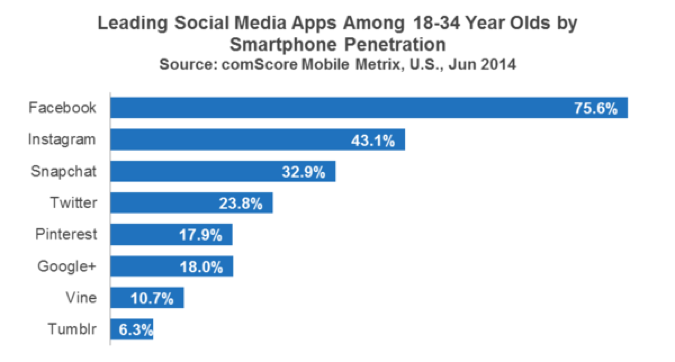
    Leading Social for Millennials

    Key Question: Is your digital and mobile strategy focused on the right platforms and generating positive social currency (referrals and recommendations)

    Impact on retail

    • Millennials are a nightmare for traditional retailers, using mobile to frequently compare product information, reviews, and price comparisons
    • Amazon is a pretty reliable digital bellwether. They added a bar code scanner/price comparison tool to their app four years ago.
    • Making the impact worse for trad retail, Nielsen reports Amazon the third most shopped retailer in the US, behind only physical behemoths Walmart #1 and Target.
    • 85% of millennials in the UK have purchased online in the last month.
    • 43% of millennials check for coupons or promotions on their smartphones
    • Mobile engagement is turning millennials into a generation focused on brands offering the maximum convenience at the lowest cost

    Key Questions:  How does your bricks and mortar strategy align to your digital strategy? Is your value proposition successfully articulated and understood by millennials focused on comparison shopping?

    Brand

    • Interestingly, millennials are the most trusting generation when it comes to advertising
    • To cut through the noise of multiple platforms and choice (and achieve the respect of millennials) marketing efforts (along with products and services) need substance and authenticity
    • This is achieved through ongoing engagement, adding value to millennials’ lives
    • Relevancy in making your brand ‘their own’ is an important component to sustaining a relationship
    • A warning though, if something doesn’t resonate, or is oversold, chances are they won’t engage

    Key Question: Does your brand engage and value millennials? 

    Where it starts to get really interesting Access not ownership

    • Otherwise known as disruption of dominant models, this is where a number of start ups focus
    • Access not ownership means Uber for Cars, Spotify for music, AirBnb for accommodation… etc etc
    • No less an expert than economist Jeremy Rifkin predicts “25 years from now, car sharing will be the norm, and car ownership an anomaly”

    Key Question: How can your business model evolve to embrace access economy rather than ownership? Or more simply if you dont disrupt yourself then someone else will.

    Key Takeaways:

    Here’s Jamie Gailewicz again – “This group (millennials) will challenge, expect more, and desire a better idea for how to live. Ignoring them may well lead to the demise of your brand”

    The good news is, even if millennials clearly have different traits to the generations before them, success in marketing to them still looks a lot like:

    Marketing is solving customers problems, driving engagement, experience, and revenue.

    KS

  • Did I miss something…?

    Did I miss something…?

    Last week saw the release of the latest radio surveys (ie, the all important audience figures).

    Commercial radio in NZ is a virtual duopoly,  with MediaWorks and NZME taking turns to whack on each other. So I guess it shouldn’t surprise both sides “see” the latest results as victories. Even so, I’m struggling to see Paul Henry a surprise winner in radio survey in the same space as Hosking dominates breakfast radio.

    The release of the numbers saw further PR salvos – Dean Buchanan (managing director NZME Radio) was “…rapt with today’s results. Newstalk ZB will just continue to strengthen further with Marcus Lush joining the team”. He also claimed “ZM is on fire with loads more growth potential… it’s a great day to be number one”.

    Hmmm…

    I completely understand the rhetoric. In a two player market appearance is all, and moves in share mean moves in revenue. But…

    These announcements are shy any comment on the real-world challenges facing radio.

    Total market audience figures give a reality check – total audience dropped by 7.9%. Drilling into ZM and The Edge (as a proxy for youth) 9.2% of the audience disappeared. These are big numbers to be deserting radio – the impact of audience loss is clearly seen in NZME Radio’s results, where revenue dropped 2% in 2014.  However, there was more to the story than meets the eye, agency revenue (the largest and most sophisticated advertisers deserted NZME radio a massive 13% in Q2.

    And if you think this is grim, the future looks even worse for traditional TV.

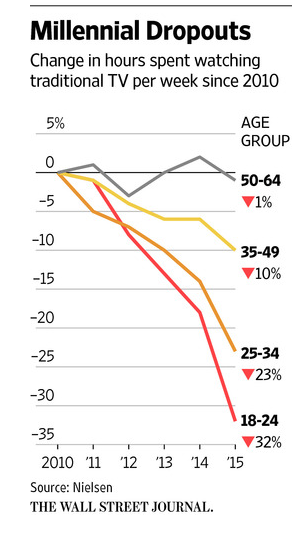
    TV with MillennialsThe latest Ericsson TV & Media 2015 report shows the massive impact of generational change on media – 82% of 60-69 year olds still watch traditional TV compared to 50% of 16-34 year olds.

    Chiming with this is a graph from WSJ. The 18-24 demographic shows a 1/3 drop in hours spent watching traditional TV… in only a five year period.  

    TV is pushing on demand and online services to arrest this decline. So is NZME with iHeart Radio. Papers and cracks… these attract audience but mean little without thought through corresponding (and company-wide) commercial strategies to arrest cash declines.

    Advertising carries less impact in digital channels. Global forecasts see TV losing between between 1-3% of advertising revenue share in the next 5 years globally, but guess what this again is masked by the fact that it is only really emerging markets that are growing.

    You’re thinking – 1-3% isn’t much versus the general audience decline, right? And you’re right.

    The issue is – media companies work on thin margins already. TVNZ had revenue of $336m and profit of $25m in 2014. Profit margins are so finely tuned that on those numbers a 7% drop in revenue would completely wipe out TVNZ’s profit.

    Here in NZ our smaller base is driving us faster to the sharp end of disruption for traditional media. To assume things will change is wishful at best, misleading at worse. The challenge for media companies is to show how they will adapt, versus hacking at each other over smaller pieces of an increasingly decreasing pie.

    The options of cutting are diminishing (to gone), so it will be fascinating to see which of them can pivot into a real-world place, based on a genuine understanding of where their audience and clients have gone. Despite executive comment on the healthy state of media most realists get that inaction is making the future worse. The fear is significant pain lies ahead.

    Key Takeaways

    • Topline numbers can give a false sense of security. Is your business realistic in its world view?
    • What do you see when you look closely at your lead indicators? Comfort or trouble?
    • If trouble… how are you tackling that?
    • Strategy and leadership is all about understanding trends and identifying the future shape of your business. It’s difficult to achieve when you’re in the trenches… do you carve out time to understand and plan for the future?
  • The power of referral marketing.

    The power of referral marketing.

    After a couple of weeks’ theoretical discussion (looking at the difference between marketing and advertising) I want to bring the discussion to life today by analysing a business showing phenomenal growth in a short life span – and all without traditional advertising.

    Uber’s short 18 months in NZ has seen a very impressive launch followed by unhindered and exponential growth. According to a recent press release, they now have over 100,000 customers, recently clocking their one millionth ride.

    So here’s my question – how many companies can you name who have reached 100,000 customers in NZ within two years… with almost no traditional advertising?


    The answer is very few – meaning it really is worth analysing their approach. In short, Uber have acquired a significant consumer base in NZ through a powerful mix of referral marketing, free samples and evangelical belief in their product.

    Referral

    Here’s one thing Uber understands… customers trust recommendations from people they know way more than advertising messages (92% vs. 24% from advertising).

    The follow up to this is referred customers show a 16% higher lifetime value than customers acquired through marketing. Uber have taken this idea and run with it.

    Their referral system is elegant and effective. If you recommend a friend to Uber, both you and your friend earn $25 credit. Obviously dual credits are a pretty compelling incentive, but due to the nature of Uber’s business there’s another hidden reason for their acquisition success.

    To use Uber you need to download and enter your credit card details into the app. In many cases this proves to be a significant customer friction – in general losing online companies big chunks of potential audience. But by giving customers $25 credit, Uber is automatically rewarding them not just for the referral BUT ALSO for the effort of credit loading. Think back to my old friend  Value = (benefits – costs)… in one fell swoop Uber’s credit reduces the cost friction of account creation, driving value to the consumer. This approach gives Uber a direct relationship between customer acquisition and cost of acquisition.


    Free Samples

    Sampling ain’t new – it’s been used by products such as the NZ Herald for years.  It’s a classic momentum play – you give samples to help spread your message and acquire audience.

    Uber have a twist – their samples are often given to people who can help spread their message. They are often be seen at conferences targeting people known to Malcolm Gladwell as Connectors/ Sales People.

    Connector / Sales people are the ones most likely to recommend a service to friends, selling the service through a mix of enthusiasm and influence, often without meaning to. They are, in short, an incredibly powerful recommendation engine.

    Even when Uber are in the thick of their regular PR storms, this too plays into their hands. Connectors love to be seen in the thick of things. For them using a service so powerfully represented in the news is actually a badge of honour.


    Evangelism and product belief

    Uber marry this innovative acquisition approach with a zealot’s belief in their product. Their confidence a sampling customer will return after an initial recommendation is high. Most customers never look back after their first Uber experience. Uber NZ stats bear this out:

    • They have 1500 drivers, and claim to be acquiring hundreds each month
    • Their average fare claims to up to 30% cheaper than comparable forms of transport, saving New Zealanders nearly $4 million to date.
    • Wait time is seriously impressive… the majority of drivers arrive in under 4 mins with an average time of 3.8 minutes

    As if this wasn’t enough, Uber recently reinforced their value as part of a celebration of their one millionth NZ ride, employing surprise and delight to offer customers two free rides.

    Key Takeaways

    • How do you connect with your customer advocates or connector / sales people?
    • Does your marketing drive sampling and repeat usage?
    • Have you gone beyond ‘standard’ above the line advertising approaches to build awareness? If not, why not?
    • Does your referral marketing ensure everyone is a winner?

    KS

  • How can it be free?

    How can it be free?

    Weve touched on Chris Andersons celebrated 2009 book Freea few times in previous posts. Not the easiest read (theres a lot of technical detail that can be difficult to follow) the book is actually based on another, equally celebrated (and luckily for us, much more accessible), piece from Anderson – the 2008 Wired magazine article Free! Why $0.00 Is the Future of Business.

    Anderson was Wired editor in chief for over a decade (moving to Wired from the Economist in 2001), with a deserved reputation for work examining digitals impact on legacy business (his other – equally celebrated – work is The Long Tail). I clearly recall the impact the original article had when I read it in Wired, and having recently re-read the piece eight years on its striking how much there is still be gained from its basic concepts.

    The article starts with an economic principle – in a competitive market, price invariably falls to the marginal cost. Two digital factors today put this principle in overdrive – in demolishing international boundaries the internet has created previously unimagined avenues to scale, with centralised resources now serving millions (and billions) globally, building the most competitive market ever. And alongside this Moore’s law seemingly defies natural laws, every year enabling exponentially more powerful service to that audience of millions, and at rapidly decreasing cost.

    And heres what that does to business – as your primary expense reduce to silicon based services, free moves from an option to the inevitable endpoint.

    Or as I may have mentioned last weekif it can be digitised it can be disrupted.

    New businesses utilising free are incredibly disruptive and destructive to legacy businesses, hamstrung with digitally insensible strategies and systems. These business enter the market and rapidly strip value from their legacy competitors – all the while operating commercially successful and digitally coherent strategies.

    Craigslist (a US version of TradeMe) began service in 1995 as a free email service featuring events in San Francisco. Evolving into a classifieds site offering free basic listings with upsell and advertising around them, by 2006 it had helped to strip some $326m (or 12%) from the value of the US classified business for newspapers. Craigslist was estimated to be earning $40m – but with of course a drastically different cost base to newspapers. The balance of value simply disappeared – nine years on from 2006 I would wager the value now stripped out of US classifieds would be closer to 95%!

    The most common free model requires three parties (the basic media model). In this model an advertiser pays to participate in an otherwise free exchange between a content producer and an audience.

    Google is probably the three party proponent most people know of – offering a seemingly unlimited number of highly featured free services (search, apps, youtube, Google Drive, unlimited photo storage) to its customersall funded by a sophisticated advertising model.

    Other common free models include:

    Freemium:

    • Usually with web software, services, and some content free
    • Free to basic users of the service
    • Example: Evernote.com  

    Advertising:

    • Usually with content services, software and more offered free
    • Free to everyone
    • Example:  www.nzherald.co.nz

    Cross-subsidies

    • Driven by a second product enticing enough for you to pay for
    • Free to everyone willing to paybe it one way or another
    • Example: Mobile phone bundled calling plans

    Labour Exchange

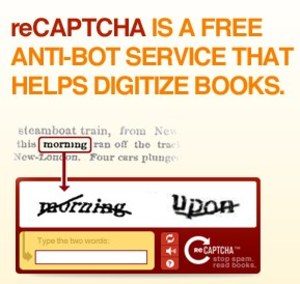
    • recaptcha-booksUsually with free websites and services
    • Free to all users, with the act of using these sites and services being the value driver
    • Example: When you are entering the key words in a scrambled text box on a log in screen you are actually helping transcode a book


    Gifting Economy:

    • Usually with free open source software or user generated content
    • Free to everyone
    • Example: Wikipedia

    Key Takeaways:

    (and, I really hope this ones getting through)

    • If it can be digitised it can be disrupted!!!
    • In a digitised world there is a race for scale, with costs plummeting, meaning free may become inevitable

    Key Questions?

    • Have you considered your industry may be headed toward free?
    • Are you seeing reductions in your input costs?  
    • If this is happening, how will you evolve your commercial model to compete and compete profitability?

    KS

  • If it can be digitised it can be disrupted

    If it can be digitised it can be disrupted

    If it can be digitised it can be disrupted…

    The role of the consultant is two-fold. Sometime you get paid to help your client see and achieve things they don’t have the resource or experience to do… the classic hired gun lending expertise to pivot a client’s business to a higher place.
    The reality is that’s quite rare – usually it’s a little more pragmatic. That doesn’t mean less valuable – just more “everyday”. That’s about helping a clientrecognise risk, understand where the market is heading, navigate choppy waters, change, and then emerge fit for new purpose.

    If it can be digitised it can be disrupted…

    A good consultant does both. A great consultant understands helping a client survive and thrive, staying in their vertical with minimal changes to their model delivers the gold.
    In the last few years a new breed of consultant has emerged – one schooled in public policy and corporate relations. These are the guys who push the envelope for new digital technology and thrive on challenging the regulatory
    status quo. Armed with consumer driven support (for cheaper and more “consumer friendly” digital innovation), political  backgrounds give them the contacts and knowledge to change industries through challenging regulations.  In many digital businesses they earn the biggest salaries and assume the same sort of importance as a valued COO.

    If it can be digitised it can be disrupted…

    So what, you might think. That sort of stuff is a little above my pay grade. But here’s the thing – what these guys do doesn’t just impact their business. It can directly  impact your business too. The goalposts they shift can render you obsolete in the blink of an eye, and just as in last week’s post, you may not see the wallop coming.

    Media and the taxi industry delivered great examples in the last week. In Europe, contracts between Sky TV UK and six Hollywood studios are under investigation by the European Commission. Clauses in their distribution
    contracts demand Sky block access to content outside of their licenced territory (eg, geo-blocking outside of the UK).  This has been standard in distribution contracts for years – technological shortfalls supported the policy,
    and it meant studios could sell the same content multiple times into multiple different territories. In today’s borderless (internet distributed) streaming environment, the policy makes less sense. And in the economically borderless EU, the Commission has averted interest in a consumer focussed level playing field for all content consumers.

    Meanwhile, in NYC aggressive and innovative marketing has driven Mayor Bill de Blasio to at least temporarily back down from his plans to hit Uber by limiting the number of ride sharing cars allowed in the city. Driven by union pressure from the Taxi and Limousine Commission (which has seen the value of a taxi license decrease by 20% since 2011), De Blasio tried to go the ecological route, citing increased congestion and pollution as reasons to limit
    ride sharing vehicles in the city. It is estimated that there are 63,000 Uber type cars in New York compared to a regulated and capped 13,500 yellow Taxis.

    If it can be digitised it can be disrupted…

    Both these industries had strong historic forms of market protection. Pressures ranging from consumer through to regulatory, all driven by digitisation, have utterly eroded these natural barriers to entry.  Laws governing these businesses were not written for digital environments, however the businesses were able to be digitised and thus disrupted. When the laws couldn’t keep up, public policy agitation became part of the disrupters arsenal – ultimately meaning wholesale change for everyone attached to both industries.and challenged by the net result This is not only a major headache for the incumbent businesses but for lawmakers as the law was not written with the digital and sharing economy in mind and is fraught with un-intended interpretations and consequences.

    Key Takeaways

    • You may have some form of technical or regulation protection for your business of industry however when your business, value chain or parts of your value chain are being digitized:
      • Will they offer the protection you need?
      • How will they be interpreted,
      • Will they need to be reworked and therefore remove your protection
    • If you have a restraint of trade with your talent, does it apply to your existing medium or web and mobile?Remember if it can be digitised it can be disrupted!

    KS

    PS: In a similar vein, the Top Gear guys have just neatly circumvented a contractual restriction on. And just off the wire is the news that the Top Gear crew have signed for Amazon Prime Video, the interesting thing about this was the presenters contract restricted them from hosting another TV car show on British television, Amazon Prime is a global deal and circumvents this restriction.

  • Six Stages of Exponential Growth

    Six Stages of Exponential Growth

    In the last week I’ve been hooked on a fantastic new book – Bold: How to Go Big, Create Wealth and Impact the World. Demonstrating the impact technology is having on change (and how technology-driven change can only continue to increase) the book has really expanded my thinking on the opportunities this is opening. It’s changed the way I view the growth of technology and its impact on both new and established businesses.

    Underpinning the book is a simple concept. Growth today is exponential and no longer linear – instead of thinking of growth as “1, 2, 3, 4 5” we should think of growth as compounding or doubling i.e. “1, 2, 4, 8, 16”.

    Likening this new growth paradigm to Einstein’s famous quote (“Compound interest is the eighth wonder of the world. He who understands it earns it … he who doesn’t pays it.”) the authors Peter Diamandis and Steven Kotler see it as imperative you disrupt your own company before someone else does. With the exponential nature of technology-driven growth, standing still is now the business kiss of death.

    The book outlines the “Six Stages of Exponential Growth” – or the Six D’s (Digitalisation, Deception, Disruption, Demonetisation, Dematerialisation, and Democratisation).

    Digitalisation – Everything is going digital, be it images, words, music, video or communications. And once digital, it then is subject to exponential growth as defined by Moores law.

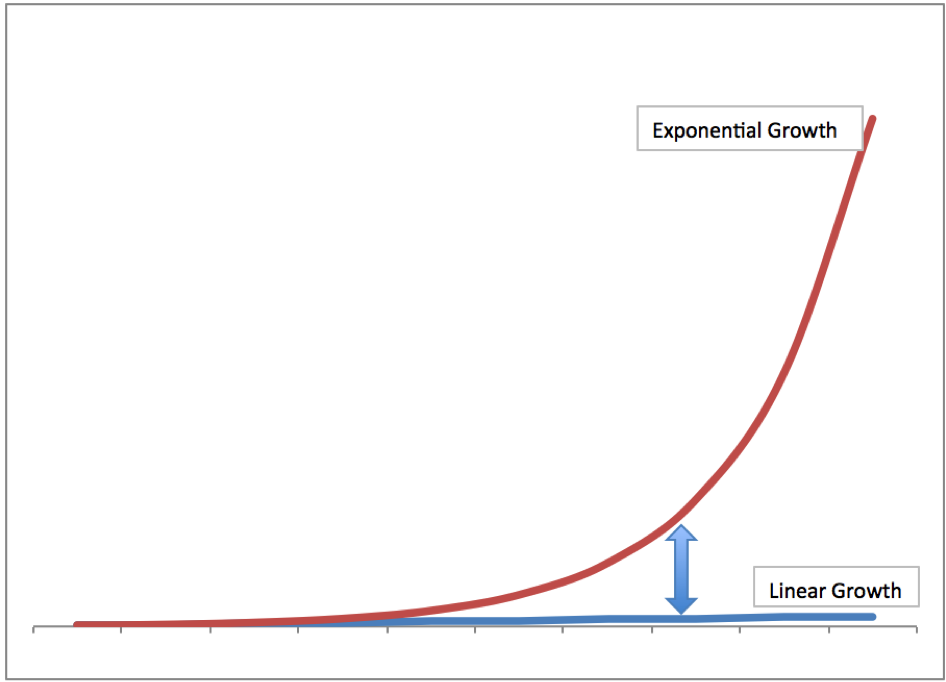
    GraphDeception – As things and products are digitised it can take time for them to hit their straps. The hype around their digitisation can falter, allowing products to fall into a deceptive period where people dismiss them. This period is doubly deceptive – despite possibly growing at a compound rate, in the early phase compound growth is not noticeably different from linear growth. The graph below illustrates this – by the time the difference between exponential and linear growth becomes noticeable the pattern is already set to explode.

    Disruption – Digitalisation increases the options for disruption – innovation and technology will either create a new market or disrupt an existing one. Unfortunately for the disrupted, disruption always follows the deception period… the initial technological threat may seem laughably insignificant in the deception stage – by the time you clock onto the growth it often has unassailable momentum.

    Demonetisation – This is when money gets removed from the equation. Referencing Chris Anderson’s Free, the authors show one of the easiest ways to make money through utilising “free”. Free was written in a coffee shop, on free wi-fi, and on a $400 netbook, utilising free Google apps. There are many examples that show this, be it Wikipedia vs. Encyclopedia Britannia or Skype vs. long distance/toll calling.

    Dematerialisation – This is when form factors change or converge, resulting in the disappearance of some goods and services. Smartphone apps are perfect examples – a phone has now replaced the calculator, the camera (still and video), the game console, the GPS, the alarm clock, even now even the iPod. Kodak’s first digital camera was 0.01megapixels, weighing 2kgs and costing approximately $US10,000. Today a 10+ megapixel camera weighing less than comes “free” with every 15 gm smartphone…

    Democratisation: This is when access becomes universal when the Masai herdsman with a smartphone can just as easily learn agri-business innovations as the Waikato farmer. Phones are deep in this phase right now – there are forecast to be 1 billion mobile phones in Africa by 2016.

    Key Takeaways:

    For me, the book’s key insights are in the first three Ds – Digitalisation, Deception and Disruption. I think they generate these five key questions:

    • Has any part of my business been digitised, and how can it be?
    • Think hard before accepting your business cannot be digitised. Consider Uber and AirBnB – they both digitised businesses traditionally considered safe due to high barriers to entry, and requirements for physical infrastructure such as cars and hotel rooms.
    • What digital trends in the couple of years have since fallen out of favour due to lack of growth – is this classic deception phase?
    • What part of my business should I be digitising and disrupting myself, getting ahead of the curve before I’m hit by new competition?
    • What does free look like for my business model?

    KS

  • The rise and rise (and rise and rise) of mobile

    The rise and rise (and rise and rise) of mobile

    A common challenge for many businesses I’ve been a part of in the last decade has been negotiating the phenomenal rise of mobile. For better or worse, we are all now glued to our smartphones – a recent Gallup survey showed 72% of smartphone users check their phones at least once an hour, 52% of check it a few times an hour or more, and 11% admitted that they check their phones “every few minutes”.

    For a traditional business, this shift can create real stress to legacy systems and operational approaches. But with huge slices of everyday life now conducted via mobile this isn’t an area businesses can get wrong.

    Just in case you have any lingering doubt on the role of mobile in everyday life, I’ve spent the last week digging into a couple of key reports (KPCB’s annual Internet trends report and ComScore’s US internet minutes of use). Some of these numbers really are astonishing, and should be at the heart of any business strategies you are considering.

    • In 19 years mobile has gone from 1% to 73% global penetration
    • That’s 5.2b mobile phone users, with 40% of these on smartphones
    • In case you think we lag, NZ has 70% penetration. That’s higher than the US (64%), equal with the UK (71%) and only showing a gap when compared with traditional early adopters such as Japan (84%)
    • Mobile data traffic is growing at 69% annually, with video streaming 55% of all traffic
    • While Comscore thinks mobile digital engagement is about to draw level with desktop, KPCB thinks it’s already surpassed it (at 51% of all traffic)
    • In the US an average of 2.8 hours of the day is spent on mobile devices
    • Mobile accounts for 28% of all digital media engagement (but delivers only 8% of advertising revenue)
    • Print has the most revenue to lose as this equation equalises, they only have 4% of the time spent on media yet enjoy 19% of ad spend
    • Millennials love smartphones – 87% are never without their smartphone, and 44% use the camera function daily

    NZ media statistics are pretty much in line with this. Mobile traffic in media surpassed desktop last year, now accounting for up to 60% of all traffic. Even Google has been forced to change their search algorithm, adapting it to place more importance on mobile and its ongoing growth.

    Of course, as consumers change so must businesses. Mobile has changed how businesses operate, often creating new possibilities – the era of web-only disruption (featuring drop shipping, group buying and exploitation of the long tail) is now morphing into newer business models, this time led by mobile only businesses. Two examples recently launched in NZ are Uber (where your mobile connects you to a taxi, private car or rideshare seamlessly, and anywhere in the world) and Semble (a JV between some of NZ’s leading telco and financial providers, turning your mobile phone into a cashless wallet).

    And it’s not just savvy start ups seeking to exploit mobile – the FT recently reported the Bank of England has approved a digital only bank, set to launch via a mobile app sometime this year.

    There’s nothing on the horizon suggesting any of this will slow anytime soon. The unique benefits of mobile and Smartphones are now being driven on by increased handset performance, faster speeds, and lower data costs.

    Some typical ways your business could be leveraging this platform and its unique benefits include:

    • Location and micro-location information (delivered by bluetooth technology and cheaply available beacons)
    • Just in time information (i.e. making a booking on Uber)
    • Contextual awareness (i.e. location matched with purchase and search information)
    • Click to call
    • Always on
    • Always present
    • Modified experience based on time of day
    • Real time and contextual push notifications

    Key Takeaways
    With consumers migrating from desktop to mobile, and smartphones already at 70% penetration, here are some of the questions you should be applying to your business and digital strategy:

    1. Do I have one?
    2. Have I considered mobile within my current digital strategy?
      • Follow up question to the above, if I don’t have a mobile strategy do I have a digital strategy?
    3. How is my customer usage different between desktop and mobile?
    4. Have I maximised the mobile experience, matching the benefits of the channel to the ways existing and potential customers interact with my brand?
    5. Am I leveraging mobile to get deeper customer insights?
    6. What opportunities and threats can mobile offer my business and customers?
    7. Are barriers to entry I have previously relied on eroded by mobile?
    8. How am I evolving my business model to match the new customer consumption pattern?

    KS

  • Trialling a free trial

    Trialling a free trial

    Sometimes digital seems so core to our everyday business life it is easy to forget the radical shifts it creates. Often (as with freemium) those shifts mean entirely new ways of doing business. But just as often a digital shift impacts a long established business practice, reimagining it and offering new opportunities for businesses willing to experiment.

    One of my favourite examples of this is the free trial.

    Although it’s been a staple of lead generation in the offline world for as long as marketing has existed, digital delivery opens up exciting new options for the free trial. Key to this is a core digital concept – testing.

    Of course, as with any new approach you still need awareness of the fish hooks…

    The free trial mechanic is simple – for a clearly defined period, eliminate price from the customer’s decision making process and you should see increased usage and uptake of the service. At the end of your free period, a large portion of the trial customers will love your product so much they will be willing to pay for it.

    I have previously discussed Freemium and there are two key differences between it and a free trial:

    1. Freemium makes a basic (but core) section of functionality available, whereas a free trial gives everything away
    2. Freemium also commits to make that core functionality available for ever, whereas a free trial is always for a limited period

    It’s this commitment at the heart of freemium (to keep core functionality free for ever) that naturally limits a marketer’s available to test and flex under this model.

    In contrast, the commitment in a free trial is clearly defined by the trial period. Digital delivery systems let the clever marketer pivot through a range of refinements to the offer during this test period. It’s this process that has reinvigorated the free trial for marketers.

    The smart marketer knows that a digital free trial now means one thing – test opportunities. Testing and refining options and scenarios around the free component can let you identify the best uptake, while assessing your best combination across levers like trial length, percentage discounts, offer expiry dates or even reduced call to action periods can help you build your best consumer proposition.

    A publishing company that shared data with me demonstrated some good learnings in their pivot from legacy free trial models to those using technology more smartly.

    Following the launch of their paywall, a particular publisher wanted to test options for maximising full paying customers. Free trials of the paywall were offered, with unlimited access, for three months.

    At the conclusion of the period, the customers were asked to convert at full price. This created a surprisingly low conversion rate, so the publisher quickly adjusted the offer – this time dropping the free component altogether and replacing it with three months access for $1. This time the initial trial numbers decreased, however those engaged were of a higher quality, producing a much higher conversion rate and uptake.

    Of course, just because digital opens up opportunity around the free trial, it doesn’t mean marketers can ignore some of the basics of their trade. The paywall example works because it pays attention to the customer value equation (Value = Benefits – Cost). A free trial of a paywalled product delivers “benefit” at extremely limited “cost” to the consumer. Once the price barrier is removed, they simply access the product for the life of the trial period, delivering real value at little or no additional “cost”.

    Other industries may struggle to meet this standard – a payroll SaaS product offering a free trial only removes one component of cost (i.e. price). The customer still needs to enter a large amount of data (IRD numbers, pay details, hours etc) before accessing their benefit (ie, paying their staff). The commitment required to set up the trial shows that there are real costs beyond price in this example – if the customer is dis-satisfied at the end of the trial the price will destroy the benefit, made worse by the additional cost of migrating between services.

    Finally, it’s vital you build into your free trial conditions to lead your customer towards your business goal at the conclusion of the free period. Understand what you are offering the customers at the end of the trial and what do you expect them to do. Again, the paywall example is good.. the ‘$1 for three month’ offer was more successful because they had already filtered out customers unlikely to ever pay. On top of that, charging a minimal amount meant taking customer payment details up front – so the conversion to a fully paid subscription became a ‘one click’ process.

    Key Takeaways

    It’s not all a free lunch… here are the core questions you need to ask yourself before embracing the free trial:

    • Have I considered the customer value equation (what is the switching cost to my customer to begin the trial and then at the end of the trial?
    • Does my free trial let me test the various combinations of levers available to optimise uptake?
    • What happens to the customer at the end of the trial, do they need to opt in or opt out and have we been clear with them on this?
    • How and with what offer am I going to re-target the customers that do not take the full priced offer at the end of the trial?

    KS